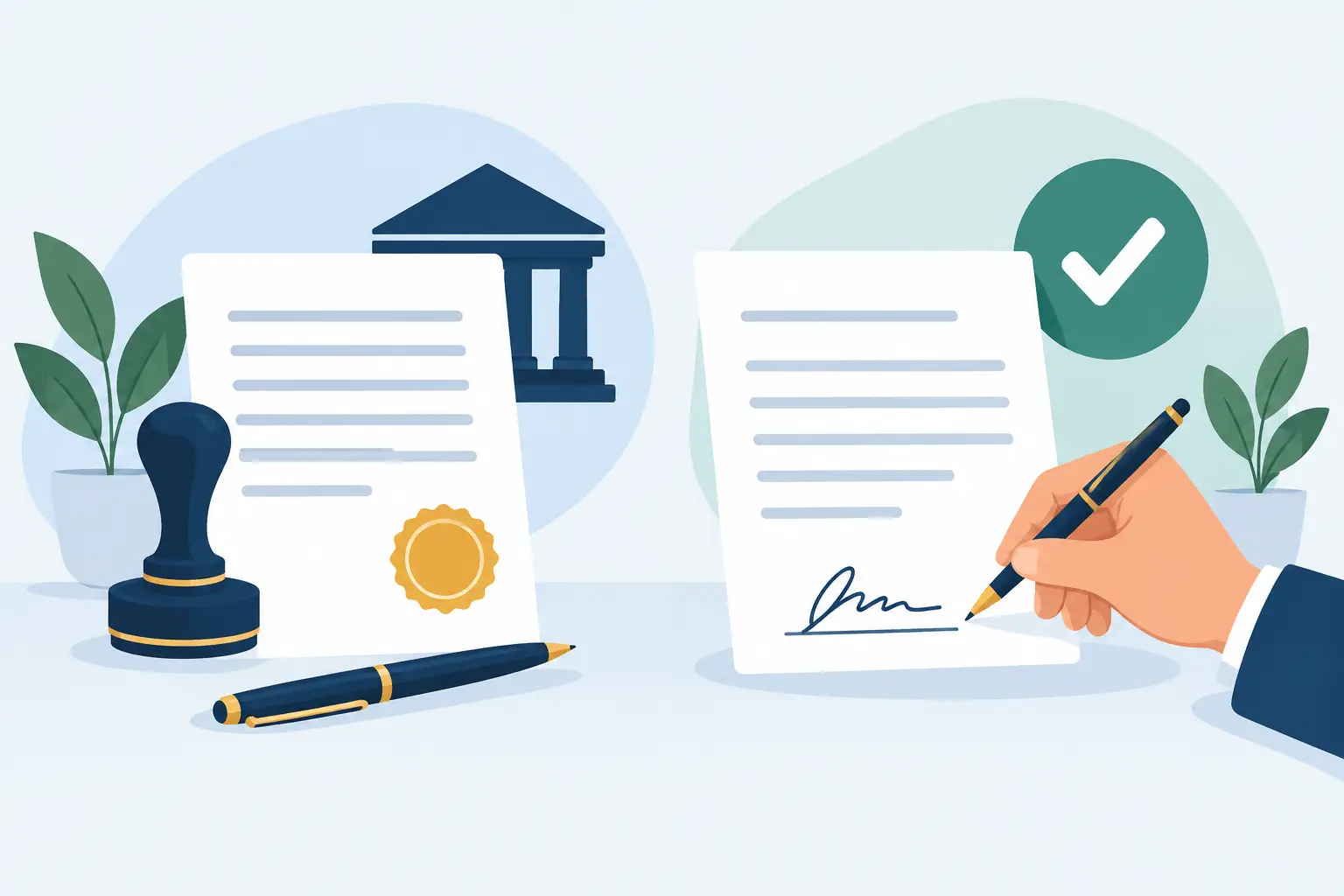
Jurat Versus Acknowledgment Form Explained

A document can be signed perfectly and still require the wrong notarial act. That is why understanding a jurat versus acknowledgment form matters before an appointment. The wording at the end of the document is not a technical afterthought. It tells the notary what the signer must do and what the notary is authorized to certify.
For Rhode Island residents, business owners, and real-estate participants, the practical question is simple: Does the document require you to acknowledge a signature, or swear or affirm that its contents are true? The answer affects whether you may sign before the appointment, whether an oath is required, and which certificate the notary completes.
The Core Difference Between a Jurat and an Acknowledgment
An acknowledgment and a jurat serve different purposes. Neither is automatically better or more legally powerful than the other. The appropriate choice depends on the document's instructions and the requirements of the receiving agency, lender, attorney, court, or other party.
An acknowledgment confirms that the signer appeared before the notary, was properly identified, and stated that they signed the document voluntarily for its intended purpose. The notary is not certifying that the document's statements are true. The notary is confirming the signer’s identity and voluntary acknowledgment of the signature.
A jurat adds a sworn or affirmed statement. The signer appears before the notary, signs in the required manner, and takes an oath or affirmation that the statements in the document are true to the best of their knowledge. The notary then completes a jurat certificate reflecting that oath or affirmation.
In plain terms, an acknowledgment focuses on the act of signing. A jurat focuses on the truthfulness of what was signed.
When an Acknowledgment Is Usually Used
Acknowledgments are common for documents that transfer, establish, or authorize rights. You may see them on deeds, powers of attorney, certain business records, real-estate documents, and agreements requiring formal execution.
With an acknowledgment, the signer may often sign before meeting the notary. At the appointment, the signer must still personally appear, present satisfactory identification, and acknowledge that the signature is theirs and was made willingly. A notary should never assume that a preexisting signature belongs to the person in front of them without completing proper identity verification and receiving that acknowledgment.
If the document has not yet been signed, the signer may generally sign during the appointment. The key requirement is that the notarial certificate accurately reflects an acknowledgment, not a sworn statement.
When a Jurat Is Usually Used
Jurats frequently appear on affidavits, sworn statements, declarations requiring an oath, verification forms, and documents submitted in matters where factual accuracy is being formally affirmed. The certificate may use language such as “subscribed and sworn to” or “signed and sworn before me.”
A jurat requires more than showing identification and confirming a signature. The signer must take an oath or affirmation administered by the notary. An oath is traditionally a solemn promise made before God, while an affirmation is a solemn promise made without religious language. Both carry the same legal seriousness.
Because the signer is swearing or affirming the document's truthfulness, a jurat generally requires the signer to sign in the notary’s presence. If the form is already signed, do not assume it can simply be notarized as written. The notary will review the certificate wording and explain the procedural steps permitted under applicable law. Depending on the situation, the signer may need to sign again in the proper place.
What “Form” Means on a Notarized Document
When people ask about a jurat versus acknowledgment form, they may be referring to the full document or to the notarial certificate attached to it. The certificate is the section completed by the notary. It usually includes the venue, date, signer information, notarial wording, the notary’s signature, commission details, and official seal.
The certificate wording controls the notarial act. A block that says the signer “acknowledged” execution calls for an acknowledgment. A block stating that the signer “swore” or “affirmed” the document calls for a jurat. The title of the document alone is not always enough to make that determination.
Some documents arrive with no certificate wording at all, a situation sometimes called a loose certificate need. That does not give the notary permission to choose the act for the signer. A notary may explain the difference between available notarial acts, but cannot decide which act meets your legal or business purpose. The receiving party, document preparer, or a qualified attorney should provide that direction when the requirement is unclear.
How to Identify the Correct Notarial Act
Before your appointment, review the document carefully, especially the final page and any attached instructions. Look for words that indicate the required act. “Acknowledged before me” points to an acknowledgment. “Subscribed and sworn,” “affirmed,” or “under oath” points to a jurat.
If a lender, title company, court, government office, attorney, or employer provided the form, ask that party which notarial certificate is required. This is particularly helpful when forms were prepared for another state or contain outdated language. Requirements can vary by jurisdiction, and the organization receiving the document is often the best source for execution instructions.
Do not rely on a friend’s prior experience with a similar form. Two powers of attorney, affidavits, or business documents may look alike while requiring different notarial acts. Accuracy comes from the actual wording and the recipient’s instructions, not from the document’s general category.
Preparing for a Correct Appointment
The simplest way to prevent delays is to bring the complete, unsigned document unless you know it requires an acknowledgment and have already signed it. Never sign a jurat section in advance if the wording requires you to sign before the notary.
Bring an acceptable, current government-issued photo ID. The name on the identification should reasonably match the name on the document. If names differ because of marriage, a middle-name variation, or another circumstance, contact the receiving party beforehand if possible. The notary must follow identification standards and cannot overlook material discrepancies simply because the signer is known personally.
Read the document before the appointment, but do not fill in information that should be completed by another party. Blank spaces, missing dates, or incomplete pages can create a serious problem. A notary is not permitted to advise you on what the document means, what information to enter, or whether signing it serves your interests.
For a jurat, be prepared to answer the oath or affirmation aloud. The process is straightforward, but it should be treated seriously. You are not being asked to explain every detail of the document to the notary. You are confirming that the statements are true to the best of your knowledge.
For an acknowledgment, be prepared to confirm that you signed willingly and understood that you were executing the document. The notary will verify identity, complete the certificate, apply the official seal where required, and follow the formal steps necessary for a proper notarization.
Common Errors That Cause Rejections
The most common mistake is using an acknowledgment when the document requires a jurat, or the reverse. A receiving office may reject the document because the notarial certificate does not match its instructions, even if the signer’s identity was properly verified.
Other avoidable errors include signing a jurat in advance, bringing an expired or unacceptable ID, leaving critical blanks in the document, and asking the notary to select a certificate without guidance from the document recipient. It is also essential that every required signer appear personally. A notary cannot notarize a signature for someone who is absent, on the phone, or represented by a relative.
Careful preparation protects the signer as well as the document recipient. Gallo Notary Services approaches each appointment with the procedural discipline needed for important personal, business, and loan-related paperwork.
When the wording is unclear, pause before signing. Obtain direction from the party that requested the notarization, bring your identification and complete documents, and let the notarial act match the certificate your document actually requires.


Comments